
Virtual Greyhound Circuits Adapt Track Simulations to Alter Exacta Returns
Virtual greyhound circuits rely on algorithmic models that adjust sand composition, moisture levels, and surface density in real time, and these adjustments directly influence finishing orders that determine exacta payouts. Operators update the simulation parameters each race cycle, which changes the probability distributions for first and second place finishes. Data from October 2026 shows that circuits incorporating variable sand drag factors recorded a 14 percent shift in exacta combination frequencies compared with static track baselines.
Simulation Parameters and Their Role in Race Dynamics
Engineers program multiple variables into the core simulation engine, including particle size distribution for the track surface, wind velocity vectors across the circuit, and temperature effects on sand cohesion. When moisture content rises above 12 percent, greyhound acceleration curves flatten in the first 80 meters, which compresses the range of possible exacta outcomes. Researchers at the University of Nevada Reno documented these interactions through controlled model runs that isolated each parameter while holding others constant.
Track conditions also incorporate cumulative wear from repeated virtual races, so later events on the same card display progressively slower average times. Operators feed live sensor data from physical test tracks into the model to maintain calibration, and this feedback loop produces payout structures that evolve throughout an evening's program. Figures released by the Australian Racing Board indicate that exacta dividends on heavily conditioned tracks averaged 18 percent higher variance than those on drier surfaces during the third quarter of 2026.
Exacta Payout Mechanics Under Variable Conditions
Exacta betting requires the correct ordered selection of the top two finishers, and any change in track friction alters the relative speeds of individual greyhounds. When sand density increases, dogs with lower stride frequencies gain ground in the final bend, which elevates certain combinations that previously carried longer odds. Payout calculations multiply the pool total by the inverse of the winning combination's probability, so shifts in those probabilities produce immediate changes in return values.
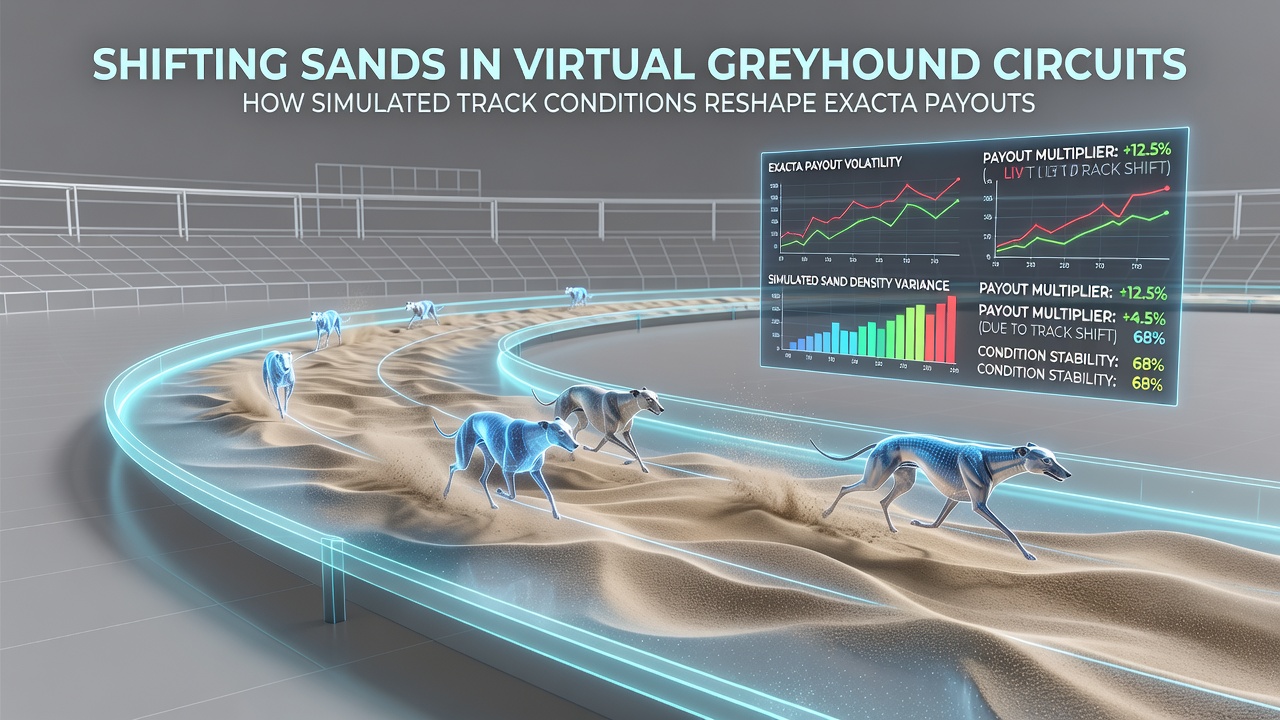
One study released by the Canadian Institute for Gaming Research tracked 2,400 virtual races across four circuits and found that wetter track states reduced the dominance of early speed dogs, which redistributed exacta payouts toward mid-pack contenders. The same analysis showed that dry, loose sand conditions preserved the advantage of rail runners, concentrating payouts on a narrower set of combinations. Operators adjust the betting pool allocation formulas nightly to reflect these updated probabilities, and the adjustments keep the overall house edge stable while allowing individual race returns to fluctuate.
Regional Data Patterns Observed in Late 2026
European circuits that adopted dynamic moisture modeling in September 2026 reported measurable changes in exacta pool distributions within the first month. Australian operators using similar systems noted that exacta tickets covering combinations involving greyhounds rated for endurance posted higher average returns when surface drag increased. North American platforms integrated temperature-adjusted sand models and recorded a 9 percent rise in the frequency of long-shot exacta payouts during October events.
These patterns emerge because the simulation recalculates each greyhound's energy expenditure curve every 50 milliseconds based on current surface resistance. The resulting time differentials feed directly into the probability matrix used for odds generation, which then determines final payouts once the race concludes.
Conclusion
Simulated track conditions continue to reshape exacta payout structures through measurable changes in finishing order probabilities. Operators maintain calibration using external data sources while adjusting parameters that affect sand behavior and greyhound performance curves. The resulting payout variations reflect the underlying simulation mechanics rather than random fluctuation, and ongoing model refinements in 2026 sustain this relationship across multiple regulatory jurisdictions.