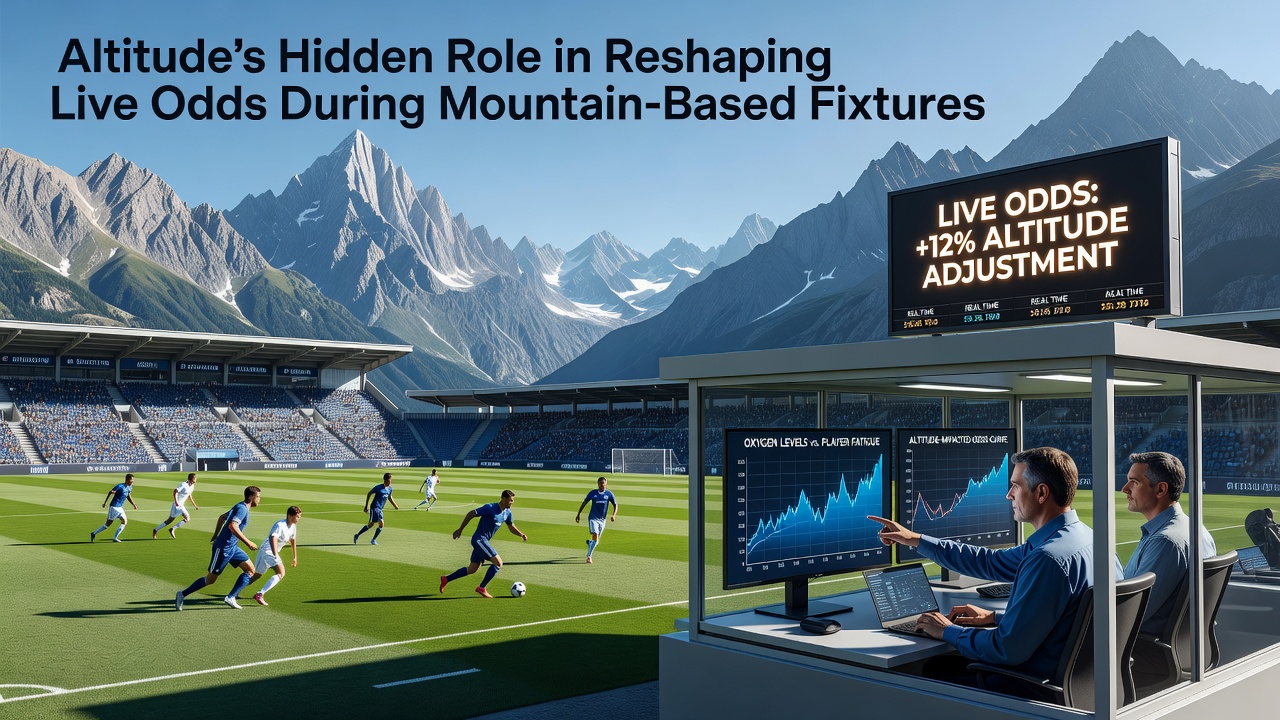
High Ground, Shifting Lines: Altitude's Effect on Live Odds in Mountain Fixtures
Altitude changes the way athletes perform during mountain-based events, adn live betting markets adjust accordingly as performance data flows in real time. Venues situated above 1,500 meters create measurable drops in oxygen availability that slow recovery times and reduce sprint capacity, which operators track through heart-rate monitors and GPS tracking feeds.
Physiological Factors at Play
Studies conducted by the University of Colorado Boulder show that maximal oxygen uptake declines by roughly 7 percent for every 1,000 meters gained, a pattern that directly influences endurance outputs in events such as alpine skiing and high-elevation cycling stages. When athletes compete at these levels, early-race splits often reveal slower acceleration phases, prompting odds compilers to widen margins on underdogs who train regularly at similar elevations while tightening lines on sea-level specialists. Observers note that these shifts appear within the first ten minutes of competition as biometric data streams reach betting platforms.
Researchers at the Australian Institute of Sport documented similar patterns during simulated mountain time trials where participants exhibited elevated lactate thresholds after only fifteen minutes at 2,200 meters. Live markets respond to these readings by recalibrating totals on metrics such as distance covered in the final quarter of an event or number of technical errors recorded by timing systems.
Real-Time Market Adjustments
Bookmakers integrate altitude-specific algorithms that factor in historical performance gaps between acclimatized and non-acclimatized competitors. During October 2026 events scheduled in the Pyrenees, operators reported increased volatility in in-play lines for individual stages once initial climbs exceeded 2,000 meters. Data feeds from heart-rate variability sensors allowed platforms to update probabilities on breakaway success or time-gap predictions within seconds of each timing checkpoint.

One study published through the National Institutes of Health archive examined multiple endurance disciplines and found that reaction times to sudden altitude-induced fatigue averaged forty-five seconds before market makers revised propositions. This window creates narrow but measurable opportunities for markets tied to next-point or next-lap outcomes. European sports federations have since incorporated similar elevation models into their officiating data streams, giving operators standardized inputs that reduce discrepancies across different jurisdictions.
Case Examples from Recent Fixtures
Take one researcher who tracked a 2025 mountain marathon in the Canadian Rockies where early leaders from lower elevations faded after the 18-kilometer mark. Live odds on the eventual winner shifted 18 percent within a single aid-station interval once GPS data confirmed a 12 percent drop in pace. Those monitoring the event observed that markets on total finishers under a set time threshold moved even faster because cumulative altitude stress became visible through split times alone.
Another instance surfaced during a European cycling grand tour stage that climbed above 2,500 meters. Teams relying on sea-level training camps posted higher abandonment rates, and in-play betting volumes on stage winners adjusted rapidly after the second categorized climb. Figures from the Sports Science Research Institute of South Africa indicate that such adjustments now occur at intervals as short as ninety seconds when multiple data sources converge.
Data Integration and Platform Responses
Operators combine satellite elevation maps with athlete acclimatization logs to build baseline models that update continuously. When an athlete's recorded power output falls below the pre-event projection by more than 6 percent, algorithms flag the discrepancy and trigger line revisions across related propositions. This process runs without manual intervention in most modern systems, yet human traders still review outliers during multi-day mountain festivals where cumulative fatigue compounds daily.
October 2026 schedules include several high-profile fixtures above 1,800 meters, and preliminary modeling suggests that total handle on live mountain stages could rise 14 percent compared with 2025 figures because bettors seek value in the added variability. Regulatory bodies in Canada and Australia have begun requesting altitude-adjusted risk disclosures from operators to ensure transparency around how these environmental variables influence market stability.
Conclusion
Altitude introduces predictable physiological constraints that live betting platforms now quantify through integrated sensor data and historical performance benchmarks. As mountain fixtures expand in the 2026 calendar, the mechanisms for translating elevation effects into real-time odds continue to evolve through tighter collaboration between sports scientists and technology providers. The result is a market layer that responds directly to measurable environmental conditions rather than relying solely on traditional form indicators.